
The banking sector's credibility is on thin ice. Unless the government takes strict steps, things could get worse.

IPO-bound hospitality major Oyo's India Chief Executive Officer (CEO) Ankit Gupta and the head of its Europe business Mandar Vaidya have resigned. A company spokesperson told Business Standard that the two had moved on from their roles six months ago in March 2023. During the same period, Oyo had rejigged its top management, where the company's COO Abhinav Sinha was reassigned as Chief Product and Technology Officer, while Chief Business Development Officer Anuj Tejpal was reappointed as Global Chief Merchant Officer.
Lack of decisiveness and courage to deal with PSBs may turn out be the biggest impediment to the Modi government's economic initiatives, says Debashis Basu.

The police said the child was shifted to a hospital in Indi where he was given preliminary treatment and was later shifted to a district hospital. He is currently stated to be stable, they said.

Life Insurance Corporation (LIC) on Monday said it has an exposure of Rs 36,474.78 crore to Adani group's debt and equity, and the amount is less than one per cent of the national insurer's total investments.

It is a good option for parents of girl children who want a debt product and do not mind its low liquidity.

'If some measures are implemented quickly, they can help revive growth.'

The MPC states that the 4 external members will have a tenure of four years each.

Will Andhra Pradesh follow the Odisha model, voting differently in Lok Sabha and assembly elections? Or will Odisha follow Andhra Pradesh, voting in new faces in both?

The Financial Sector Legislative Reforms Commission, chaired by Justice B N Srikrishna, has suggested a non-sectoral, principle-based approach to revamp the existing framework.
.jpg)
Companies are legally allowed to invest in markets in India, but the practice has seldom stirred central bank concern until recently, when they have become much more active players.

Five state-run general insurance companies have a total exposure of Rs 347.64 crore, or 0.14 per cent of their total assets under management (AUM), in Adani group of companies, the finance ministry said on Monday. In a written reply to a question by Congress' Manish Tewari, Minister of State for Finance Bhagwat Karad said Life Insurance Corp (LIC) held Rs 35,917.31 crore in debt and equity of Adani group of companies as on December 31, 2022. This is 0.97 per cent of its total assets under management (AUM) of Rs 41.66 trillion.

Whether it was the MGNREGS or the NFSA or the Aadhaar-based DBT scheme for cash transfer, the Modi government has built on the basic architecture created by the Singh government. Policy makers in the Modi government, instead of discarding them as products of the previous political regime, worked on them, expanded their scope and reach, and used new tools to improve their performance, explains A K Bhattacharya.

According to an Andhra government statement, Naidu 'reposed confidence' in the PM's leadership.
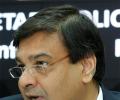
Chetan Ghate, Pami Dua and Ravindra Dholakia have been appointed for 4 years

For women, it is important to build an emergency fund and a financial independence fund independent of the couple's joint goals and plans.

The finance ministry has put out a revised draft in public domain.

The stock market regulator's definition of large, mid, and small-cap companies has irked mutual fund managers, reports Samie Modak.
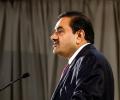
In the context of market integrity, the IRAI and RBI should go over the minutes of the LIC and SBI board meetings when the decisions to invest in Adani equity or debt were taken, notes Jaimini Bhagwati, former World Bank treasury professional.

Patience can be rewarding. 'Post-listing, sanity often returns to valuations of newly-listed businesses within six to nine months. Buy then.'

The issue is likely to be discussed on Thursday at a meeting of Sebi's board, which would also be apprised of the impact of the Finance Ministry's decision for not agreeing to such a proposal from the capital markets regulator, sources said.
.jpg)
At the retreat, PSBs had suggested the government cut its stake in these entities to less than 51 per cent over a period of time and empower the boards of individual banks.

Every defaulter is not a wilful defaulter who has the capability of paying back and is yet not servicing the bank loan, observes Tamal Bandyopadhyay.

Since the inception of the code, the threat of insolvency has brought many debtors in line

Finance Minister Nirmala Sitharaman on Saturday reviewed the performance of public sector banks (PSBs) on various financial health parameters and their resilience in the wake of the current global financial scenario emanating from the failure of some international banks in the US and Europe.

Billionaire Gautam Adani has said the decision to withdraw a fully subscribed share sale of the flagship firm of his group was primarily because of volatility in the market. Adani Group company stocks have lost over $90 billion in value since a US short seller made damning allegations. Adani Enterprises Ltd's Rs 20,000 crore follow-on public offer managed to get investors on the last day of the share close on Tuesday.

Debt-ridden telecom operator Vodafone Idea on Tuesday approved the allotment of equity shares worth Rs 16,133 crore to the government, which post-allocation has become the largest shareholder with a 33.44 per cent stake in the company. The shares have been allocated to the government in lieu of conversion of interest dues arising from deferment of adjusted gross revenue and spectrum auction payments, the company said in a regulatory filing. "...it is hereby informed that the board of directors of the company has, at its meeting held today approved the allotment of 16,133,198,899 equity shares of face value of Rs 10 each at an issue price of Rs 10 per equity share aggregating to Rs 161,331,848,990 to the Department of Investment and Public Asset Management, Government of India," the filing said.

Shares of Life Insurance Corporation (LIC) of India hit fresh record lows amid sustained decline in Adani Group stocks. Its stock finished at Rs 567.8, down 2.9 per cent over its previous close. The state-owned insurer's market value is now down Rs 2.4 trillion, or 40 per cent, compared to initial public offering levels.

If a 5% to 10% fall in the equity market gives you sleepless nights, you are not cut out for a 75% to 80% allocation to equities and must reduce it.

Defence public sector undertakings (PSUs) have been asked by the Centre to hold roadshows in Dubai and Abu Dhabi to share their financials and business plans to reel in investors. Hindustan Aeronautics (HAL), Bharat Dynamics (BDL), Bharat Electronics (BEL), Garden Reach Shipbuilders & Engineers (GRSE), and Mishra Dhatu Nigam (MIDHANI) have informed stock exchanges that they will conduct investor outreach programmes and participate in 'non-deal' roadshows and meetings with prospective investors from September 12-15. They will share their short- and medium-term growth plans, financial metrics, improvement in their stock performance/ market capitalisation - and make a pitch of sorts to prospective investors.

Billionaire Gautam Adani-led group's renewable energy firm on Thursday announced plans to raise Rs 12,300 crore through a share sale to investors as the group continues to build on a comeback strategy to emerge out of allegations of fraud levelled by a US short-seller. Adani Green Energy Ltd in a stock exchange filing said its board has approved raising up to Rs 12,300 crore through an issue of equity shares by way of qualified institutional placement (QIP). The funds are intended to be used for meeting capital needs of the company's expansion plans.

Funding winter and corporate governance woes separated the men from the boys in the country's startup space in 2023 that saw funds into the segment tapering to just around $8 billion. All said, investors are hopeful of strong growth of the maturing startup ecosystem in the new year. Edtech and health tech segments that grew exponentially during the pandemic plunged into an abyss of financial uncertainties, with several firms shuttering their business, and valuation of prominent players like BYJU'S and PharmEasy plummeting 85-90 per cent.
'They have since only tried to improve systems. Also, with regulatory guidance from time to time, we are in a position to assess a situation and react in time.'

"We will raise Rs 300 crore via bonds of two-, three- and five-year tenures. This will be our maiden bond issuance and is part of our effort to widen funding sources," says Vimal Bhandari, executive vice-chairman and chief executive officer (CEO), Arka Fincap. The firm, a subsidiary of Kirloskar Oil, is only five years old and small (assets of around Rs 5,000 crore with an "AA" rating), but the response to this float will be closely watched: It would be the first by a non-banking finance company (NBFC) after Mint Road upped the risk weights on bank exposures to them by 25 percentage points. The move by the Reserve Bank of India (RBI) has caught NBFCs off guard even though the issue had been flagged by Governor Shaktikanta Das with their corner-room occupants (and that of banks) in July and August 2023 - on consumer credit and the dependency on bank borrowings.

Investors need to evaluate how they stack up against other high credit quality fixed-income options before putting money in them.
The sad truth is that the debt-to-GDP ratio will shoot up close to 90 per cent in the coming year, and the fiscal deficit glide path does not promise to reduce it substantially any time soon, predicts Mihir S Sharma.
'Those who come from outside are surprised at the relatively small strength of the RBI supervisory cadre, relative to the needs of the country and the needs of the financial sector.'

Richest Indian Gautam Adani's ports-to-power-to-cement conglomerate is "deeply overleveraged" with the group predominantly using debt to invest aggressively across existing as well as new businesses, CreditSights, a Fitch Group unit, said on Tuesday. In a report titled 'Adani Group: Deeply Overleveraged', CreditSights said, "In the worst-case scenario, overly ambitious debt-funded growth plans could eventually spiral into a massive debt trap, and possibly culminate into a distressed situation or default of one or more group companies." Starting out as a commodities trader in the late 1980s, the Adani group has diversified from mines, ports and power plants into airports, data centers and defence.
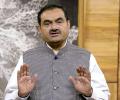
Embattled billionaire Gautam Adani on Thursday spoke publicly for the first time since his ports-to-energy conglomerate publicly battled a short seller's accusation of stock manipulation and accounting fraud, saying the abrupt move to withdraw a fully-subscribed share sale at his flagship firm was due to market volatility. His group continued to lose on the stock market, with the cumulative rout now nearing $108 billion in a week -- one of the biggest wipeouts in India's history. "After a fully subscribed follow-on public offering (of Adani Enterprises Ltd), yesterday's decision of its withdrawal would have surprised many.

While India won't be immune to global spillovers, we need to create the macro preconditions for sustained growth. Policy agility, prudence, and resilience will be key, suggests Sonal Varma.
